 Marques Jeevan Menon
The AI Stewardship Framework
Who owns the intelligence, who gains from it, and who keeps the right to decide.
A way of asking about artificial intelligence that begins with people, not with capability: what stays scarce when intelligence becomes abundant.
One minute on keeping humanity in the loop
Sixty seconds, drawn in ink and narrated. Every word is also written on the screen as you listen, so it works with the sound on or off.
Read along: the words in the film
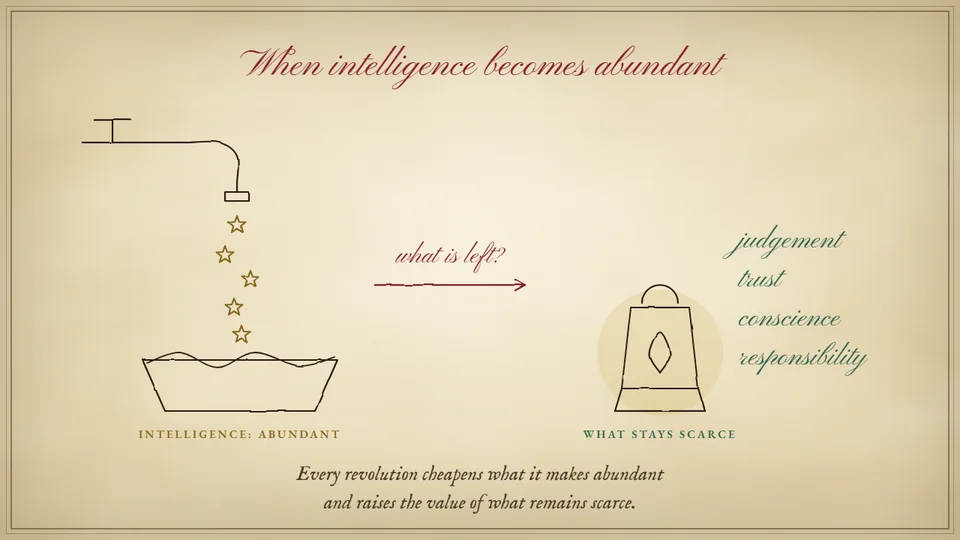
- When intelligence becomes abundant
Every revolution cheapens what it makes abundant
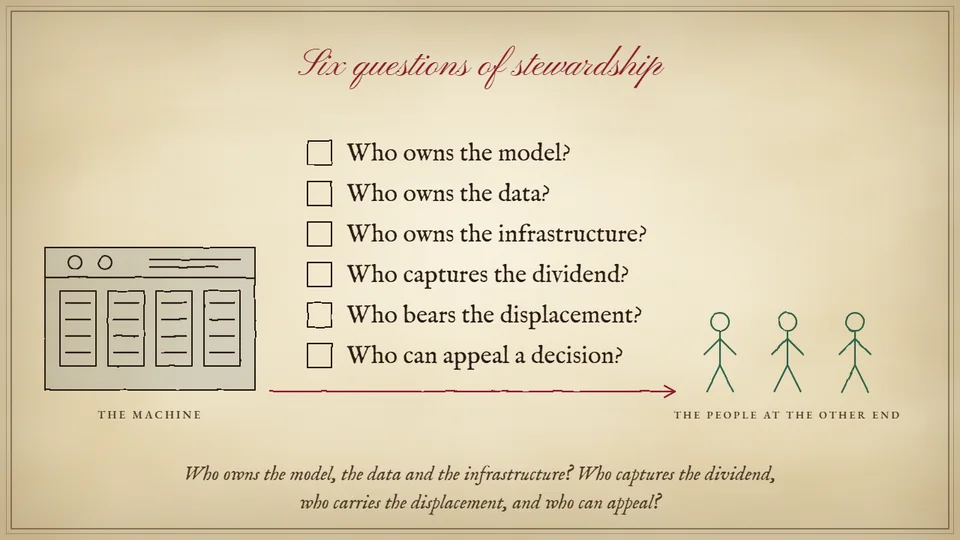
and raises the value of what remains scarce. - Six questions of stewardship
Who owns the model, the data and the infrastructure? Who captures the dividend,
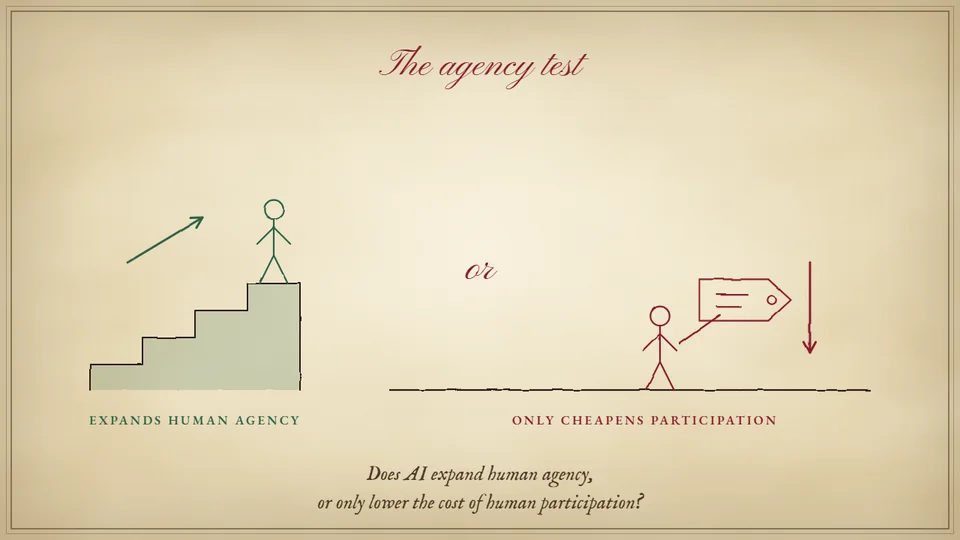
who carries the displacement, and who can appeal? - The agency test
Does AI expand human agency,
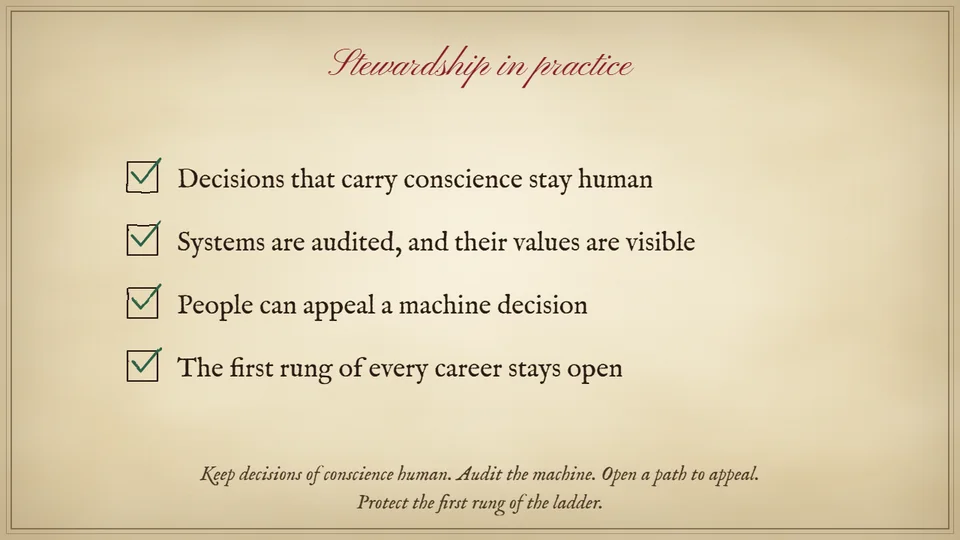
or only lower the cost of human participation? - Stewardship in practice
Keep decisions of conscience human. Audit the machine. Open a path to appeal.
Protect the first rung of the ladder.
The AI Stewardship Framework, in plain words.
Marques argues that the AI conversation has become fixed on capability: can it be built, scaled, sold or regulated. Those are necessary questions, but they are not the most important one.
Every revolution cheapens what it makes abundant and raises the value of what stays scarce. As intelligence itself becomes abundant, what grows scarce is humanity: presence, judgement, trust, conscience, responsibility, moral courage and shared memory. He believes the next great advantage will belong not to those who deploy the most AI, but to those who cultivate the most human stewardship.
Stewardship, in his sense, is different from management. The AI Stewardship Framework asks who owns the model, the data and the infrastructure; who captures the productivity dividend and who bears the displacement; what happens to entry-level pathways and to human expertise; which decisions must remain human; whose values are built in; who audits the system; and who can appeal its decisions.
Behind every one of those questions sits a single test: does AI expand human agency, or does it only reduce the economic cost of human participation? He sees national AI literacy, making AI the new digital literacy for every worker, teacher and citizen, as part of the answer.
Four moments from the film